
When a CFO or finance director is evaluating a consolidation and reporting platform, the first question is rarely about features. It is about returns: how long before this investment pays for itself, and what does the payback actually look like? The ROI of financial consolidation software is not a single number arrived at on go-live day. It accumulates across three distinct phases, each delivering a different category of value. Understanding that timeline, and being able to quantify it, is what separates a well-governed technology investment from one that struggles to justify renewal.
This guide walks through each phase with a structured framework. Finance teams can use it to build a credible business case before implementation and to track actual returns once the platform is live.
Phase One: The First Six Months

The earliest returns from a consolidation platform are largely operational. They show up in hours reclaimed, not in strategic outcomes. That does not make them insignificant: for many finance teams, the volume of manual effort consumed by month-end and quarter-end processes is considerable, and even modest reductions translate directly into cost savings and capacity freed for higher-value work.
Where the time savings come from
Before a consolidation platform is in place, a common pattern is finance staff manually extracting data from multiple source systems, formatting it into spreadsheets, reconciling intercompany balances by hand, and then repeating much of the process when errors surface. Each of these steps carries a time cost and an error risk.
A consolidation platform automates data collection, applies consistent transformation rules, and flags exceptions before they become reporting problems. The time saving per close cycle varies by organisation size and complexity, but finance teams running multi-entity consolidations frequently find that close cycles which previously took ten to fifteen working days can be reduced to five or fewer once the platform is properly configured.
A sample calculation framework for Phase One
- Hours saved per close cycle: Estimate the current total hours spent across the finance team on manual data gathering, reconciliation, and error correction for a single month-end close. Multiply by twelve for an annualised figure.
- Cost of reconciliation errors: Assign a conservative cost to each error that requires correction after initial reporting: analyst time to investigate, senior review time, and any restatement effort. Even at a modest frequency, this adds up across a full reporting calendar.
- Licence and implementation cost: This is the denominator. Divide the annualised time savings (converted to a monetary value using average finance team rates) by the total implementation cost to establish a simple payback period.
Most organisations find that time savings alone, captured in the first six months, account for a meaningful portion of the platform’s first-year cost. The deeper returns come later.
Phase Two: Months Six to Eighteen
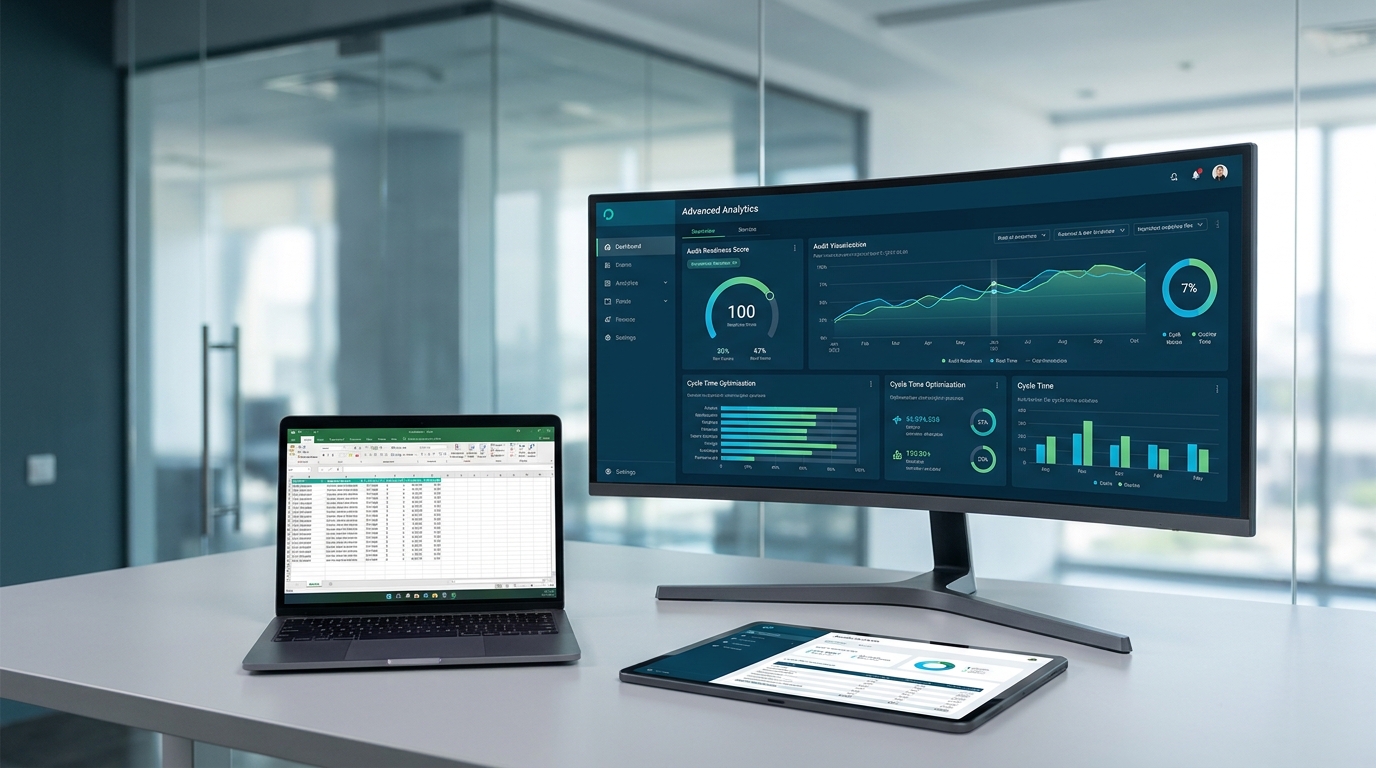
Once the platform is embedded and finance teams have moved past initial adoption, a second layer of value becomes visible. This is the optimisation phase, and its returns are centred on accuracy, audit readiness, and close cycle speed.
Accuracy gains and their downstream value
Reporting accuracy is not only a compliance matter. Inaccurate consolidated figures affect board decisions, covenant calculations, budget allocations, and investor communications. The cost of a material error is rarely limited to the time spent correcting it. Reputational risk, regulatory scrutiny, and the internal cost of restating previously published figures all form part of the true exposure.
A well-configured consolidation platform enforces consistent accounting logic across entities, automates intercompany eliminations, and provides a clear audit trail for every figure in the output. For finance teams that have historically relied on manual checks to manage this risk, the reduction in error frequency during this phase is typically significant.
Faster close cycles and what they enable
A faster financial close is not just an efficiency metric. It changes what management can do with financial information. When consolidated results are available three days earlier, executive teams have more time to interpret them, more opportunity to respond to variances, and a stronger basis for operational decisions before the next period begins.
During the optimisation phase, organisations that have embedded their consolidation platform effectively often report that close cycle reductions compound: the discipline introduced by the platform prompts improvements in upstream data quality, which further accelerates the close in subsequent periods.
Audit preparation time
Audit season is a consistent pressure point for enterprise finance teams. The time spent pulling supporting documentation, reconciling audit queries, and responding to reviewer requests is substantial. A consolidation platform with a complete and accessible audit trail reduces this burden materially. Auditors can follow a transaction from source to consolidated output without requiring the finance team to reconstruct the journey manually. In the optimisation phase, this saving often appears as a measurable reduction in overtime hours during audit periods.
To quantify this in your framework: estimate the total hours your finance and accounting teams spend on audit preparation annually, including query responses and documentation retrieval. Apply a conservative 30 to 40 percent reduction as a planning assumption, and convert that to a monetary value. It belongs in your ROI model.
Phase Three: Eighteen Months and Beyond

The strategic value phase is where a financial consolidation platform delivers returns that are harder to quantify but often the most commercially significant. This is where the financial consolidation platform ROI argument shifts from efficiency to competitive advantage.
Improved forecasting and planning quality
When consolidated actuals are clean, timely, and consistently structured, they become the foundation for better planning. Finance teams can build forecasting models on reliable data rather than spending planning cycles cleansing and reconciling inputs. Scenario modelling becomes more credible because the baseline figures are trusted by the business.
This is not a marginal improvement. Organisations that make planning decisions on unreliable consolidated data carry a systematic risk of misallocation: capital directed to the wrong entities, headcount approved against inflated projections, or cost-cutting applied where the underlying data does not actually support it. Better forecasting, built on accurate consolidation, reduces that risk across every planning cycle.
Compliance confidence at scale
Regulatory requirements for financial reporting continue to evolve, and the pressure on multi-entity enterprises operating across jurisdictions is particularly acute. A consolidation platform that is maintained and updated by a knowledgeable implementation partner gives finance leaders a degree of compliance confidence that manual processes simply cannot provide.
This matters most during periods of regulatory change, merger and acquisition activity, or rapid geographic expansion. The platform’s ability to accommodate new entities, new reporting standards, and new consolidation structures without requiring a full rebuild is a strategic asset that compounds in value over time.
Evidence from the field
The strategic case for a consolidation and expense management platform is well illustrated by the results achieved for a South African financial services provider, where Adapt IT EPM delivered up to R7.5 million in annual telecommunications savings. The scale of that outcome reflects what is achievable when a structured platform replaces fragmented, manually managed spending across a large enterprise. The same principles apply in consolidation: visibility, control, and consistent data governance produce measurable financial outcomes, not just process improvements.
Building Your ROI Calculation Framework
The following metrics give finance teams a practical starting point for modelling the enterprise performance management ROI timeline for their own organisation.
Input metrics to capture before implementation
- Current close cycle duration (working days from period end to consolidated close)
- Total finance hours per close cycle (across all entities and consolidation tasks)
- Average fully-loaded cost per finance hour (salary, benefits, overhead)
- Number of intercompany eliminations processed manually per period
- Annual audit preparation hours (finance team time only)
- Cost of errors identified post-close (investigation, correction, and reporting)
- Number of reporting entities and current consolidation tool (spreadsheet, legacy system, or hybrid)
Target reductions to model
- Close cycle duration: target a 40 to 50 percent reduction by month twelve
- Manual reconciliation hours: target a 60 percent or greater reduction by month six
- Audit preparation time: target a 30 to 40 percent reduction by the first full audit cycle post-implementation
- Reporting errors requiring correction: target near-elimination of systematic intercompany discrepancies within the first two close cycles
Plot these reductions against your implementation and annual licence costs. For most mid-to-large enterprises, the model will show payback within twelve to eighteen months, with the strategic value of Phase Three representing a return that continues to grow as the business scales.
Adapt IT EPM’s clients have achieved returns of up to 400% ROI across more than 10,000 implementations in Africa and beyond. That range reflects the diversity of organisations and use cases, but it also reflects the compounding nature of returns when a consolidation platform is embedded properly and supported through its full lifecycle.
The Implementation Phase Determines the Outcome
A consolidation platform only delivers its projected ROI if the implementation is well-governed. Poorly scoped implementations, underestimated data migration complexity, and inadequate user adoption planning are the most common reasons that Phase One returns are delayed and Phase Two improvements never fully materialise.
This is why the approach taken to Corporate Enterprise Performance Management at Adapt IT EPM is built around consultation and co-creation rather than software delivery alone. The configuration decisions made during implementation shape every return the business will see for years afterwards. Getting those decisions right requires deep understanding of the client’s consolidation requirements, reporting structures, and integration landscape.
For finance leaders evaluating consolidation platforms, the questions to ask are not only about the software. They are about the implementation methodology, the post-implementation support model, and the partner’s track record in similar environments. The platform is the vehicle; the implementation is what determines whether it reaches its destination.
Putting the Timeline to Work
The ROI of financial consolidation software follows a predictable arc when implementation is well-managed and adoption is supported. Phase One delivers operational savings within the first six months. Phase Two builds accuracy and close cycle improvements through to month eighteen. Phase Three converts those foundations into strategic advantages that grow with the business.
For finance leaders building a business case, the framework above provides the structure. For those already in implementation or post-go-live, it provides a benchmark against which to measure progress and identify where additional optimisation is available.
If you are working through a consolidation platform evaluation or want to understand what a realistic ROI model looks like for your specific environment, book a consultation with the Adapt IT EPM team. The conversation starts with your business, not with a product demonstration.

As the Professional Services Lead within the Adapt IT EPM division, Desmond brings 25 years of expertise to the table. Over the past 5 years at Adapt IT, his focus has been on delivering successful implementations and world class support on BOARD Technology and IBM Cognos Controller. This allows our clients to use a modern platform for their EPM solutions that drive efficiencies. Desmond’s responsibilities encompass Leading the Professional Services team in their implementations and support. He is deeply passionate about EPM solutions that improve budgeting, consolidation and reporting processes and he is an avid motorcycle tourer in his spare time.