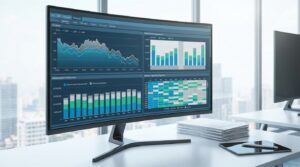
In today’s fast-paced business world, gaining a competitive edge is more than a goal, it’s a necessity. In this blog, we explore how integrated analytics and business intelligence tools help organisations navigate uncertainty, streamline decision-making, and improve business performance. We’ll discuss how leveraging real-time data and predictive analytics enables business leaders to make smarter, data-driven decisions that drive success.
Let’s explore how integrated analytics can empower your business to not just survive but thrive.

Planning in the Age of Volatility
Markets today are anything but predictable. Whether it’s global supply chain disruptions, shifting consumer demands, or unexpected regulatory changes, volatility has become the norm.
Traditional, rigid planning models often leave businesses exposed, unable to pivot quickly when circumstances change.
Agility has emerged as a vital competitive edge, the ability to adapt strategies in response to new information is essential for long-term resilience. This is where integrated analytics come into play.
By consolidating data from multiple sources and providing real-time, actionable insights, these analytic tools enable businesses to make informed decisions at speed, helping them stay ahead of the curve.
The Pitfalls of Traditional Planning Models
Traditional planning models, while once effective, are now showing their cracks in an unpredictable world. Static, annual plans often become outdated before they can be fully implemented. Siloed departments and manual processes create bottlenecks, leading to delays and miscommunication.
Without real-time data, decision makers are left in the dark, relying on outdated or incomplete information to guide their strategies. This lack of visibility results in operational inefficiencies, missed opportunities, and ultimately, a competitive disadvantage.
Consider the volume of data generated across modern organisations, from sales figures and customer feedback to supply chain metrics and marketing campaigns. Without the right analytic tools, it’s impossible to harness this wealth of information effectively.
Businesses that continue to rely on outdated models risk falling behind as more agile competitors seize opportunities and innovate faster.
This is where agile planning comes in!
Defining Agile Planning and Its Key Components
So, what does agile planning really mean? At its core, agile planning is a dynamic approach that enables businesses to respond quickly to change. Rather than rigid, top-down strategies, agile planning fosters flexibility, allowing teams to pivot as new data emerges.
A key component of agile planning is the integration of advanced analytics and real-time data. With self-service analytics, decision-makers can monitor key data points, track performance, and identify trends as they occur, not after the fact.
Predictive analytics plays a vital role, too. By analysing historical data and identifying patterns, predictive models help organisations anticipate future outcomes. This forward-looking approach empowers decision makers to make data-driven decisions based on potential scenarios, rather than reacting to issues as they arise.
In essence, agile planning isn’t just about moving faster; it’s about moving smarter. It’s about aligning business strategies with the realities of today’s complex, ever-changing markets.
Let’s dive into the role of integrated analytics.

The Role of Integrated Analytics in Agile Planning
Integrated analytics is the engine that drives agile planning. By combining data from multiple sources, such as sales platforms, financial systems, supply chains, and marketing campaigns, into a single, unified view, businesses can transform raw data into meaningful and actionable insights.
This consolidation enables decision-makers to see the full picture, understand the relationships between different metrics, and make well-informed choices.
AI-powered analytics platforms take it a step further by automating scenario modeling, forecasting, and risk analysis, providing businesses with insights they might have otherwise missed.
With real-time data and predictive analytics at their fingertips, businesses can spot trends early, identify areas for improvement, and take proactive steps to optimise operations.
The result? Enhanced operational efficiency, faster response times, and a stronger competitive edge. Integrated analytics doesn’t just make data more accessible, it transforms the way organisations plan, act, and achieve their goals.
Use Case: How Board Technology Enables Agile Planning
Let’s look at how a platform like Adapt IT EPM’s Board solution supports agile planning in the real world.
This solution combines powerful analytics capabilities, business intelligence dashboards, and integrated data sources in a user-friendly platform designed to scale with your business.
With this solution, decision-makers can access real-time data visualisations and build predictive models without relying on IT teams or complex coding.
This self-service approach empowers business users across departments, from marketing and sales to finance and operations, to contribute to a more agile planning process.
Sector-specific adaptability is a standout feature of this solution. Whether it’s finance, manufacturing, retail, or services, this technology enables businesses to align strategies with industry-specific drivers.
Collaborative features, such as shared dashboards and scenario planning tools, foster cross-functional alignment and improve communication between teams.
In a fast-moving business environment, tools like this ensure that strategy and execution are always aligned, enabling businesses to stay ahead of market shifts and make confident, data-driven decisions.
Benefits for Strategy Leaders and Operations Executives
For strategy leaders, integrated analytics provides a clear competitive advantage. This technology enables faster responses to market changes, reduces risks, and fosters a more proactive approach to business growth.
Data from multiple sources comes together in real time, giving leaders the clarity they need to make decisions that drive results.
For operations executives, the benefits are equally compelling. Agile planning supported by integrated analytics helps streamline processes, improve resource allocation, and reduce inefficiencies.
It also fosters better collaboration across departments, ensuring that teams are aligned and working towards shared goals.
Ultimately, the return on investment is clear, improved business performance, reduced costs, and a stronger market position.

Conclusion
From the above, it is clear that in today’s fast-moving markets, success hinges on the ability to plan and act with precision. As a trusted Board International partner, Adapt IT EPM implements this powerful technology while delivering the integrated analytics, planning, and reporting capabilities needed to make it truly effective. With real-time dashboards, predictive models, and cross-functional collaboration tools, this solution transforms complex data into actionable insights. This empowers your teams to make faster, smarter, and more strategic decisions. Whether you’re streamlining group reporting or enabling agile planning across departments, this unified platform gives you the visibility and control to outperform the competition.
Ready to transform your business strategy with integrated analytics? Download our Financial Planning Whitepaper today for expert insights and practical tips. Or book a demo to explore how Adapt IT EPM can help you streamline your operations, make smarter data-driven decisions, and achieve your goals with confidence.

As the Professional Services Lead within the Adapt IT EPM division, Desmond brings 25 years of expertise to the table. Over the past 5 years at Adapt IT, his focus has been on delivering successful implementations and world class support on BOARD Technology and IBM Cognos Controller. This allows our clients to use a modern platform for their EPM solutions that drive efficiencies. Desmond’s responsibilities encompass Leading the Professional Services team in their implementations and support. He is deeply passionate about EPM solutions that improve budgeting, consolidation and reporting processes and he is an avid motorcycle tourer in his spare time.